
For anyone who has ever calculated their Total Daily Energy Expenditure (TDEE) only to find the results don’t match their real-world experience, you’re not alone. The science of measuring human energy expenditure is far from static. While online calculators provide a essential starting point, a new wave of research is revealing why a one-size-fits-all number often falls short and how we can move toward truly personalized estimates. This article digs into the limitations of standard equations, explores the gold-standard methods used in scientific research, and provides a practical framework for refining your TDEE for effective, sustainable weight management.
Why Your TDEE is More Than Just a Number: The Limitations of Predictive Equations
Most TDEE calculators rely on predictive equations like Mifflin-St Jeor or Harris-Benedict. These formulas estimate your Basal Metabolic Rate (BMR) based on age, gender, height, and weight, which is then multiplied by an activity factor . While incredibly useful, these models are based on population averages and can struggle with individual variations.
Recent studies highlight specific scenarios where these equations can be inaccurate:
- In Hospital Settings: Predictive equations frequently underestimate energy needs for patients who are underweight or at nutritional risk and overestimate for patients with obesity (BMI ≥30) . This demonstrates how metabolic health and body composition significantly alter actual energy expenditure in ways simple formulas can’t capture.
- In Specific Populations: Research on Brazilian adults found that equations from international organizations (like the Dietary Reference Intakes) substantially overestimated TDEE when compared to direct measurements . This underscores the potential impact of ethnic and regional differences on metabolism, suggesting that global standards may not be universally applicable.
The takeaway is clear: your TDEE is a dynamic number influenced by a complex interplay of factors beyond the basic inputs in a calculator. Understanding this is the first step toward a more accurate and personalized approach.
The Gold Standard: How Scientists Measure Energy Expenditure
To move beyond estimates, it’s helpful to understand the more precise methods used in research. These techniques help validate the predictive equations and reveal their shortcomings.
- Doubly Labeled Water (DLW): Considered the “gold standard” for measuring TDEE in free-living individuals, DLW involves drinking water containing stable, non-radioactive isotopes. By tracking the rate at which these isotopes leave the body through urine over 1-2 weeks, scientists can calculate total carbon dioxide production and thus total energy expenditure with high accuracy . Its major advantage is that it allows people to go about their normal lives without disruption. However, it is prohibitively expensive and requires sophisticated analysis, making it unsuitable for everyday use.
- Indirect Calorimetry: This method is the gold standard for measuring Resting Metabolic Rate (RMR), a key component of TDEE. It measures a person’s oxygen consumption and carbon dioxide production at rest to calculate energy expenditure. It’s often used in clinical settings to precisely determine the caloric needs of patients . While more accessible than DLW, it still requires specialized equipment.
These methods confirm that while predictive equations are a good proxy, they are not perfect. The error between these precise measurements and equation-based estimates can be significant, sometimes exceeding 10-15% . This gap is where personalization becomes critical.
The Impact of Weight Loss on Your TDEE
A crucial and often frustrating phenomenon for many is metabolic adaptation during weight loss. As you lose weight, your TDEE decreases not just because you are carrying less mass, but because your body becomes more efficient. A 2025 study highlighted that “TDEE declines rapidly during the early phase of weight loss” . This means the calorie deficit that worked when you started may become less effective over time, leading to the infamous weight loss plateau. Recognizing this adaptive process is key to adjusting your strategy and maintaining motivation.
From Estimate to Action: A Practical Framework for Personalizing Your TDEE
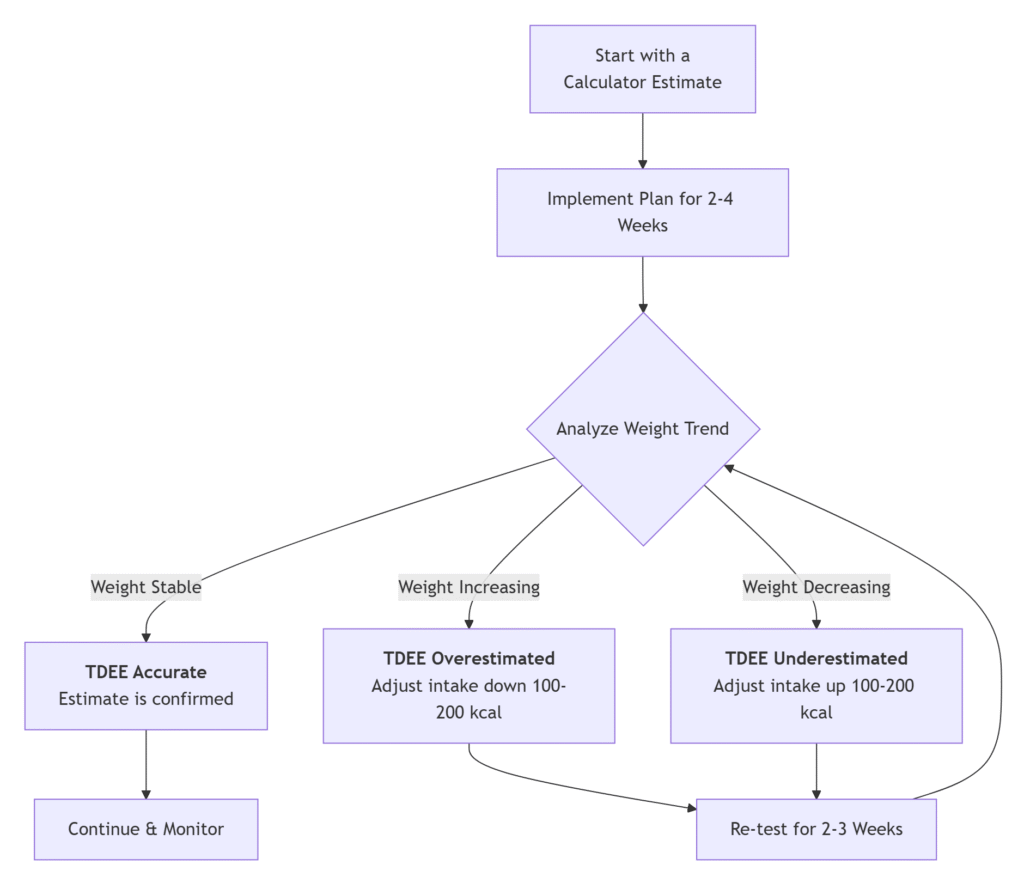
Given the limitations of calculators, how can you zero in on your true TDEE? The most effective method combines initial estimates with real-world observation and adjustment. The following framework outlines this iterative process.
Step 1: Use the Calculator as a Starting Point
Begin by getting an estimate from a reliable TDEE calculator, which uses the established equations . This number is your hypothesis, not your final answer. It provides a scientifically grounded starting point for your experiment.
Step 2: Implement and Track Meticulously
For a minimum of 2 to 4 weeks, maintain a consistent daily calorie intake based on your goal (maintenance, loss, or gain). At the same time, track the following with consistency:
- Nutrition: Use a food scale and tracking app for accuracy. Estimations can lead to significant errors.
- Weight: Weigh yourself daily at the same time under the same conditions (e.g., upon waking, after using the bathroom) and calculate the weekly average. Daily fluctuations are normal; the trend over time is what matters.
- Activity: Maintain a consistent activity level. If your exercise routine changes significantly, you may need to reassess.
Step 3: Analyze and Adjust
After the tracking period, compare the expected outcome with the actual result. The flowchart above illustrates the decision-making process for weight maintenance. The same logic applies to weight loss or gain goals, but compared against your expected weekly rate of change.
This process turns a static calculation into a dynamic, living number that reflects your unique metabolism.
Advanced Considerations: Body Composition and Energy Availability
For athletes and highly active individuals, two advanced concepts are vital for both performance and health.
- The Role of Body Composition: TDEE is heavily influenced by your body’s composition. Muscle tissue is more metabolically active than fat tissue, meaning it burns more calories at rest. Therefore, two individuals of the same weight can have different TDEEs if one has a higher percentage of muscle mass . This is why incorporating strength training into your routine is so beneficial for long-term weight management—it helps build or preserve muscle, which supports a higher TDEE.
- Relative Energy Deficiency in Sport (REDs): This is a serious health condition that can occur when an athlete’s energy intake is insufficient to support the energy expended by exercise and basic bodily functions. A 2025 study suggested that a low ratio of measured Resting Metabolic Rate to predicted RMR may be a more sensitive indicator of REDs risk than other calculations in active females . This highlights the critical importance of adequate fueling for anyone with high activity levels, not just for performance but for overall health.
The Future of TDEE Estimation
Research continues to seek more accessible and accurate methods. Studies are exploring the use of 24-hour physical activity recalls and time-weighted averages during weight loss interventions to create better models . The future likely holds more personalized approaches, potentially integrating data from wearable devices and genetic markers to move ever closer to a truly individualized TDEE.
Conclusion: Embrace the Process
Understanding your TDEE is not about finding one perfect number but about engaging in an ongoing process of learning about your body’s unique energy needs. By starting with scientific estimates, diligently tracking your personal data, and being willing to adapt based on real-world results, you can move beyond generic formulas. This empowers you to create a diet and exercise plan that is not only effective but also sustainable, turning the science of energy expenditure into the art of personalized health.
References
- Bossan, F. M., dos Anjos, L. A., Ferriolli, E., & Pfrimer, K. (2025). Total daily energy expenditure estimated by 24-hour physical activity recalls and doubly labeled water in urban Brazilian adults. Nutrition, 138, 112815.
- Using Time-Weighted Averages of Total Daily Energy Expenditure to Estimate Energy Intake During a Weight Loss Intervention. (2025). Obesity (Silver Spring).
- Methods for estimation of nutritional expenditures for hospitalized patients may not be sufficiently specific. (2025). Clinical Nutrition.
- Use of Resting Metabolic Rate Ratio as a Relative Energy Deficiency in Sport Indicator. (2025). Current Developments in Nutrition.
